

 English
 Español
Content
- 1 The Short Answer: Sun In, Battery Charged, LEDs On at Dusk
- 2 How a Solar LED Light Works, Component by Component
- 3 Why Winter Is the Real Test for Solar LED Lights
- 4 What Makes a Solar Light "High Efficiency" for Cold Months
- 5 What IP65 Waterproofing Means for a Solar Floodlight
- 6 How Motion and Light Sensors Extend Winter Run Time
- 7 How to Install a Solar Floodlight for Maximum Winter Output
- 8 Quick Buying Checklist and Common Problems
The Short Answer: Sun In, Battery Charged, LEDs On at Dusk
A solar LED light works in four steps: a photovoltaic panel turns sunlight into electricity, a charge controller sends that power into a rechargeable battery, a light sensor detects darkness, and the battery then powers the LEDs overnight. There is no wiring and no electricity bill. For winter, the practical rule is to choose a panel of at least 10% of the battery's watt-hour rating in watts per sun-hour deficit, a LiFePO4 battery, and an IP65 or higher enclosure.
The rest of this guide explains each component, why winter exposes weak designs, and how to judge a high-efficiency IP65 waterproof solar floodlight with sensor before you buy.
How a Solar LED Light Works, Component by Component
Every LED solar light, from a garden stake to a 300W floodlight, uses the same five building blocks. Quality differences come from how well each one is made and matched to the others.
Solar panel (photovoltaic cell)
Silicon cells generate direct current when photons knock electrons loose. Monocrystalline panels typically reach 20% to 23% efficiency, while polycrystalline panels sit around 15% to 17%. Higher efficiency means more charge from the same small surface area, which matters most on short winter days.
Charge controller
This circuit prevents overcharging and deep discharge, which are the main causes of early battery failure. Better units use MPPT (maximum power point tracking), which can harvest 15% to 30% more energy than basic PWM controllers in low light.
Rechargeable battery
The battery stores daytime energy. Common types are NiMH, lithium-ion, and LiFePO4. LiFePO4 is preferred for outdoor use because it tolerates thousands of cycles and handles heat better.
LED module
LEDs convert electricity to light far more efficiently than halogen or incandescent bulbs. Good chips deliver 150 to 200 lumens per watt, so a small battery can run a bright fixture for hours.
Photocell and motion sensor
A photocell switches the light on when ambient light drops below a threshold, usually around 10 lux. A PIR (passive infrared) motion sensor can then dim the light to 10% to 30% until it detects movement, then boost to full brightness. This one feature can stretch battery life several times over.
Why Winter Is the Real Test for Solar LED Lights
Winter combines three problems: fewer sun hours, a lower sun angle, and cold batteries. In many northern regions, a panel receives roughly 1 to 3 peak sun hours per day in December, compared with 5 to 7 in summer. A light that works perfectly in July can fail by 10 p.m. in January if it was designed with no margin.
Cold affects battery performance
Lithium-ion cells cannot be safely charged below 0°C (32°F), and capacity drops noticeably in the cold. Cheap lights without low-temperature charge protection either stop charging or degrade quickly. Look for products that specify a charging range that includes sub-zero temperatures or that use LiFePO4 with built-in thermal management.
Snow and frost block the panel
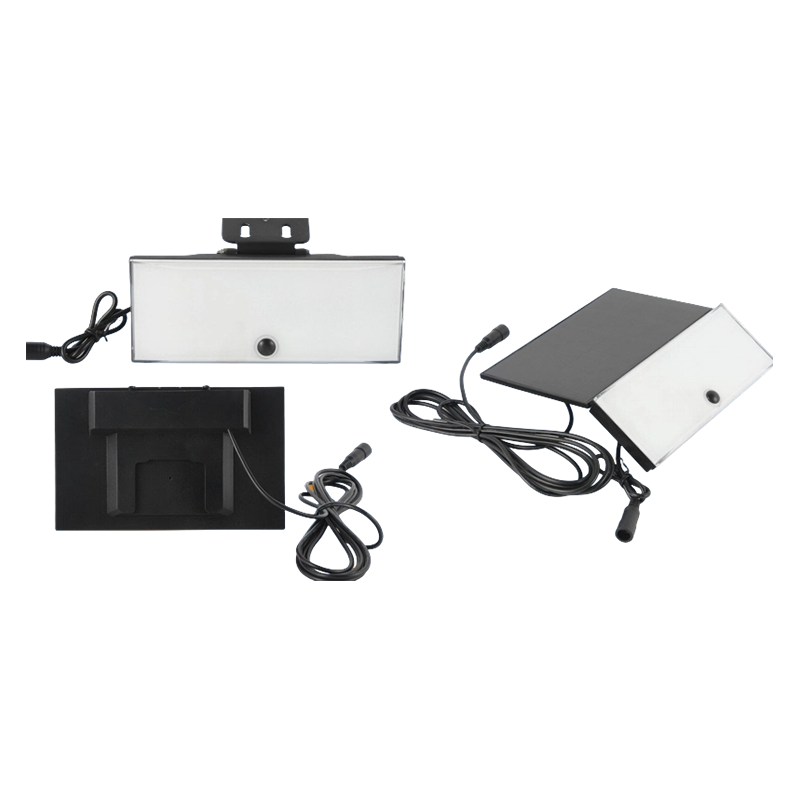
Even a thin layer of snow can cut output by 80% or more. A tilted panel, ideally at an angle close to your latitude plus 10 to 15 degrees, helps snow slide off. Separate-panel designs let you mount the panel where it gets the best exposure while the light sits elsewhere.
Long nights drain batteries
Winter nights in some areas last 14 to 16 hours. Running a floodlight at full power all night would need a huge battery, which is why dusk-to-dawn sensor modes and dimming matter so much.
What Makes a Solar Light "High Efficiency" for Cold Months
Efficiency is a chain, and the weakest link sets the result. Use the specifications below to compare products.
| Component | Basic Spec | Winter-Ready Spec |
|---|---|---|
| Panel type | Polycrystalline, 15-17% | Monocrystalline, 20-23% |
| Charge controller | PWM | MPPT |
| Battery | Li-ion or NiMH | LiFePO4, 2000+ cycles |
| LED efficacy | 80-100 lm/W | 150+ lm/W |
| Lighting mode | Full brightness only | Dim-and-boost with PIR sensor |
| Cold tolerance | Not specified | Charges and discharges below 0°C |
Also check the panel-to-battery ratio. As a quick example, a 20Ah 3.2V LiFePO4 battery stores about 64Wh. A 20W panel in 2 peak sun hours produces roughly 40Wh before losses, so it will not fully recharge in one winter day. A 30W to 40W panel gives far more margin for cloudy stretches.
What IP65 Waterproofing Means for a Solar Floodlight
The IP code has two digits. The first digit (6) means the housing is completely dust-tight. The second digit (5) means it withstands low-pressure water jets from any direction, such as heavy rain or a garden hose. That is enough for nearly all residential and commercial outdoor use.
IP65 versus IP66 and IP67
- IP65: protects against rain, sleet, and snow, and suits walls, fences, and eaves.
- IP66: withstands powerful jets and is a good choice for coastal or storm-prone sites.
- IP67: survives temporary immersion to 1 meter, which is useful where water can pool, such as ground-level paths.
Check the weak points
Ratings apply to the sealed housing, not always to cable joints or panel connectors. Look for silicone gaskets, waterproof cable glands, and die-cast aluminum or UV-stable ABS bodies. In freezing climates, trapped moisture that expands as ice can crack poor seals, so a tested IP65 claim from a reputable brand is worth paying for.
How Motion and Light Sensors Extend Winter Run Time
Sensors are the cheapest way to add hours of illumination without enlarging the battery. A typical floodlight mode works like this: the photocell turns the light on at dusk, the light holds at 20% brightness, and when the PIR sensor detects movement within 8 to 12 meters, it jumps to 100% for 20 to 30 seconds.
Consider a 40W floodlight at full power. A 64Wh battery would last about 1.6 hours. At 20% standby brightness (8W) with a few short boosts, the same battery can last 7 to 8 hours. That is the difference between a light that dies at midnight and one that lasts until sunrise.
Useful sensor settings to look for
- Adjustable detection range and sensitivity, to avoid false triggers from trees or small animals.
- Selectable modes, such as sensor-only, dim-plus-sensor, and constant on.
- Adjustable light-on duration after motion stops.
- A remote control, so you can change modes without a ladder.
How to Install a Solar Floodlight for Maximum Winter Output
Placement can change charging results as much as the hardware itself. Follow these steps for the best performance.
- Face the panel toward true south in the Northern Hemisphere (north in the Southern Hemisphere).
- Tilt the panel to roughly your latitude plus 10 to 15 degrees to catch the low winter sun and shed snow.
- Check for shade between 9 a.m. and 3 p.m. on the shortest day of the year, because a single branch shadow can cut a panel's output sharply.
- Mount the light 2.5 to 4 meters high for the best sensor coverage and wide beam spread.
- Charge the battery fully with the switch on before first use, ideally for one to two sunny days.
- Wipe frost, dust, and bird droppings off the panel monthly with a soft cloth.
Quick Buying Checklist and Common Problems
Use this checklist when comparing an LED solar light for cold-season use. Be skeptical of "1000W" or "2000W" labels on small solar floodlights, because these are often marketing equivalents rather than real power draw. Look for real wattage, lumen output, battery watt-hours, and panel wattage.
- Stated battery capacity in Wh or mAh with voltage, not just "large capacity".
- Monocrystalline panel with a clearly stated wattage.
- IP65 or higher rating, plus a warranty of at least 12 months.
- Operating temperature range that covers your local winter minimum.
- Mode options with PIR sensor and dusk-to-dawn function.
Troubleshooting common winter issues
| Problem | Likely Cause | Fix |
|---|---|---|
| Light turns off early | Undersized panel or battery | Use a lower brightness mode or upgrade panel wattage |
| Does not turn on at dusk | Photocell shaded or switch off | Clear the sensor and check the power switch |
| Flickers or turns on during the day | Heavy overcast or snow on the panel | Clear the panel and reposition for open sky |
| Battery will not charge | Below-freezing cutoff or aged cells | Wait for warmer temperatures or replace the battery |